

You want a mobile app. Right away you face hard questions. iPhone or Android? One app or two? And how much will it all cost? React Native has a simple answer: build the app once, run it on both. Here is what it is, in plain words, and why so many teams pick it.
JavaScript is the most-used programming language in the world, used by 66% of all developers
React Native uses exactly that language. That means many developers already know it, so it is easier to find a team, faster to hire, and less risky if someone leaves (Stack Overflow Developer Survey, 2025).
In this article:
What is React Native?
React Native is a technology from Meta, the company behind Facebook and Instagram. One team builds one app. That same app then runs on both iPhone (iOS) and Android. You do not write it twice. And it is not a website wrapped in an app. It looks and feels like a real app.
This is not a niche tool. It is one of the most used app technologies in the world. Over 2.3 million projects run on it (GitHub, the largest platform for developers, 2026). Meta uses it in its own apps too. So it keeps getting better, year after year. It is not going away.
In one sentence
React Native is the "build once, run on both" approach: one team, one build, both iPhone and Android.
Why is React Native a good choice?
The short answer is money and time. Because one app serves both systems, 70-90% of the work is reused for iPhone and Android instead of done twice, which cuts cost by 30-50% versus building two separate apps (TekRevol, 2025). But the savings are only part of the story. Here is what you actually get:
- One codebase, two platforms. You pay for and maintain one app instead of two. A fix or a new feature lands on iOS and Android at the same time.
- Lower cost and faster launch. Sharing most of the code means less work, so the app is cheaper and reaches the market sooner.
- Easy to find a team. It uses JavaScript, the most common programming language in the world (Stack Overflow, 2025), so there are plenty of developers and you are not dependent on one person.
- Quick changes. Developers see every change on the phone within seconds, which speeds up building and testing.
- Lots of ready-made building blocks. Thousands of ready solutions (payments, maps, notifications) mean common features do not have to be built from scratch.
With native, the same app is written twice. With React Native, 70-90% is reused, depending on how complex the app is.
All of this is why React Native usually wins on price. For the concrete numbers per app type, see our guide on mobile app cost.
Which big apps are built with React Native?
The best proof that React Native is ready for real use is who trusts it. Its official list includes Instagram, parts of Facebook and Messenger, Microsoft (Office, Outlook, Teams), Amazon apps and Shopify (React Native Showcase, 2026). These are apps used by hundreds of millions of people, not demos.
Discord
Discord runs a top-rated iPhone app on React Native with just 3 developers on it. The app almost never crashes (99.9% crash-free) and has a 4.8-star rating (Discord Engineering, 2019). A small team, a huge result.
Shopify
Shopify moved its whole app to React Native. It reports the app almost never crashes, and most screens open fast (Shopify Engineering, 2025). Proof it holds up for serious commerce.
The more popular the app, the more likely it uses React Native. Source: AppBrain, June 2026.
How close is it to native performance?
Close enough that most people cannot tell the difference. The old complaint that React Native felt slow largely no longer holds. In October 2024 a major update (version 0.76) made apps noticeably faster and lighter (React Native, 2024).
smaller app size
faster median app startup
faster for developers when making changes
Source: React Native 0.76 release notes, October 2024.
For everyday business apps this speed is more than enough. Think shops, bookings, social apps, apps with content. There are a few cases where native is still faster. They are rare, and we cover them honestly below.
How long does development take with React Native?
Faster than two separate apps, because you build once instead of twice. A rough guide for a business app: a working MVP (the first usable version) lands in weeks, not months, and a full app follows from there. React Native shortens each of these stages because one codebase serves both iPhone and Android.
MVP (first usable version)
a full-featured app
release for both stores at once
Indicative ranges; the exact timeline depends on features and design complexity.
The single biggest factor in the timeline is scope - how many features and how complex the design is. For a breakdown by app type and what each stage costs, see our guide on mobile app cost, or compare the types of mobile apps to see where React Native fits.
React Native vs Flutter vs native
React Native is a leading choice, but not the only one. Its main rival is Flutter, made by Google. Flutter is great too. In some developer surveys it even beats React Native. So this is an honest comparison, not a sales pitch. The main difference is the language each one uses. React Native uses JavaScript, the most common one. Flutter uses Dart. Native uses Swift for iPhone and Kotlin for Android.
| Criterion | React Native | Flutter | Native |
|---|---|---|---|
| Language | JavaScript / React | Dart | Swift / Kotlin |
| Code reuse iOS + Android | 70-90% | 70-90% | 0% (two apps) |
| Talent pool | Very large (JS) | Growing | Specialized |
| Performance | Very good | Very good | Maximum |
| Backed by | Meta | Apple / Google | |
| Best for | Business apps, first version | Apps with a custom design | Games, heavy graphics |
For a small or medium business, the JavaScript advantage often tips the scale toward React Native: it is simply easier and cheaper to find and replace developers, which lowers your long-term risk.
When Flutter is the better choice
To be fair, Flutter can be the stronger pick in two cases: when you want a pixel-identical custom look across both platforms (Flutter draws its own UI, so it fully controls every detail), and when your team already knows Dart or comes from a native background. In those situations Flutter can be just as good or better. For most business apps where finding developers and reusing web/JavaScript skills matter more, React Native stays the safer default.
When is React Native not the right choice?
Honesty builds trust, so here is the other side. React Native covers most apps very well. But it is not the answer to everything. In these cases, native is usually the better call:
- Games and heavy 3D graphics. High-end games and graphics-heavy apps push the phone to its limit, where native or a dedicated game engine does better.
- Features deeply tied to the phone. An advanced camera, AR (augmented reality) or heavy background tasks often need custom code written separately for each system, so full sharing is rare.
- You already have a strong native team. If your team lives and breathes Swift and Kotlin, switching tools may cost more than it saves.
For everything else - shops, services, bookings, content, social, internal business tools - React Native is usually the sweet spot.
From our experience: EcoHunt on one codebase
This is not just theory for us. EcoHunt is a gamified mobile app we built that turns recycling into a game with points and a leaderboard. We chose this one-app-for-both approach on purpose: it let us launch on iPhone and Android at the same time and spend the time on the game itself, instead of writing everything twice.

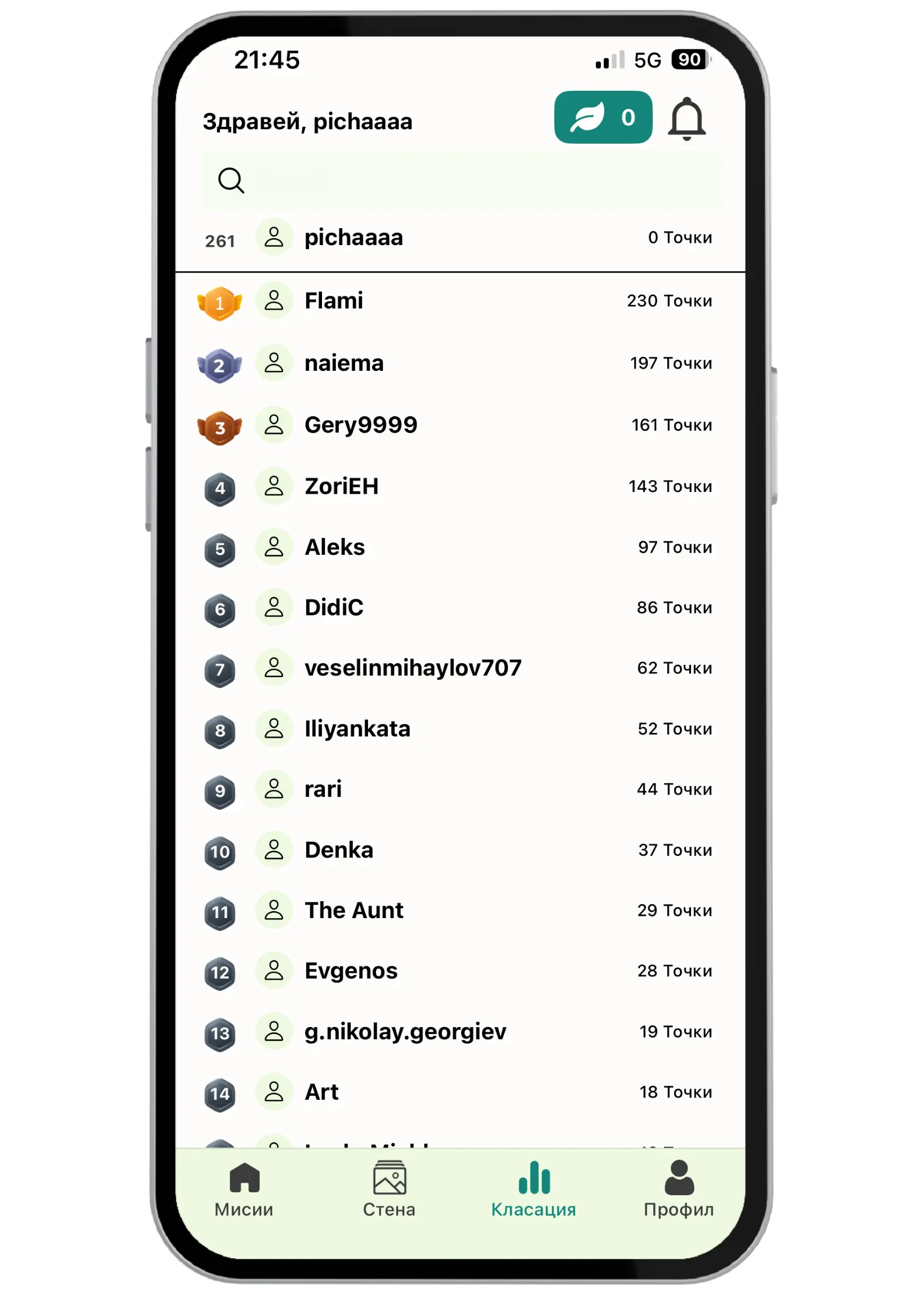
Concretely, that meant one codebase instead of two, a single team building both versions in parallel, and iPhone and Android going live together rather than one after the other - with every later feature and fix shipping to both stores at once. The result is one app with the same feel on both platforms. You can see the full project in our EcoHunt case study.
Is React Native right for your mobile app?
For most small and medium businesses, the answer is yes. You get one app for both platforms, a lower price, a faster launch and a large pool of developers. That means your budget goes into features that bring in customers and strengthen your online presence, not into maintaining two separate apps. The same logic that made Discord and Shopify pick it applies to a local shop or a service business.
Want to know if it fits your idea? See the prices in our guide to mobile app cost, or go straight to our mobile app development service and we will tell you honestly whether React Native, a PWA or native is the right call for you.
Frequently asked questions
Sources
All sources retrieved on 7 June 2026.
- Stack Overflow, Developer Survey 2025 (Technology), 2025 - survey.stackoverflow.co
- React Native (Meta), Showcase, 2026 - reactnative.dev
- React Native (Meta), 0.76 - New Architecture by default, 2024 - reactnative.dev
- GitHub, facebook/react-native, 2026 - github.com
- Discord Engineering, How Discord achieves native iOS performance with React Native, 2019 - discord.com
- Shopify Engineering, Five years of React Native at Shopify, 2025 - shopify.engineering
- AppBrain, React Native Android SDK statistics, 2026 - appbrain.com
- TekRevol, Native vs Cross-Platform Development Costs, 2025 - tekrevol.com