
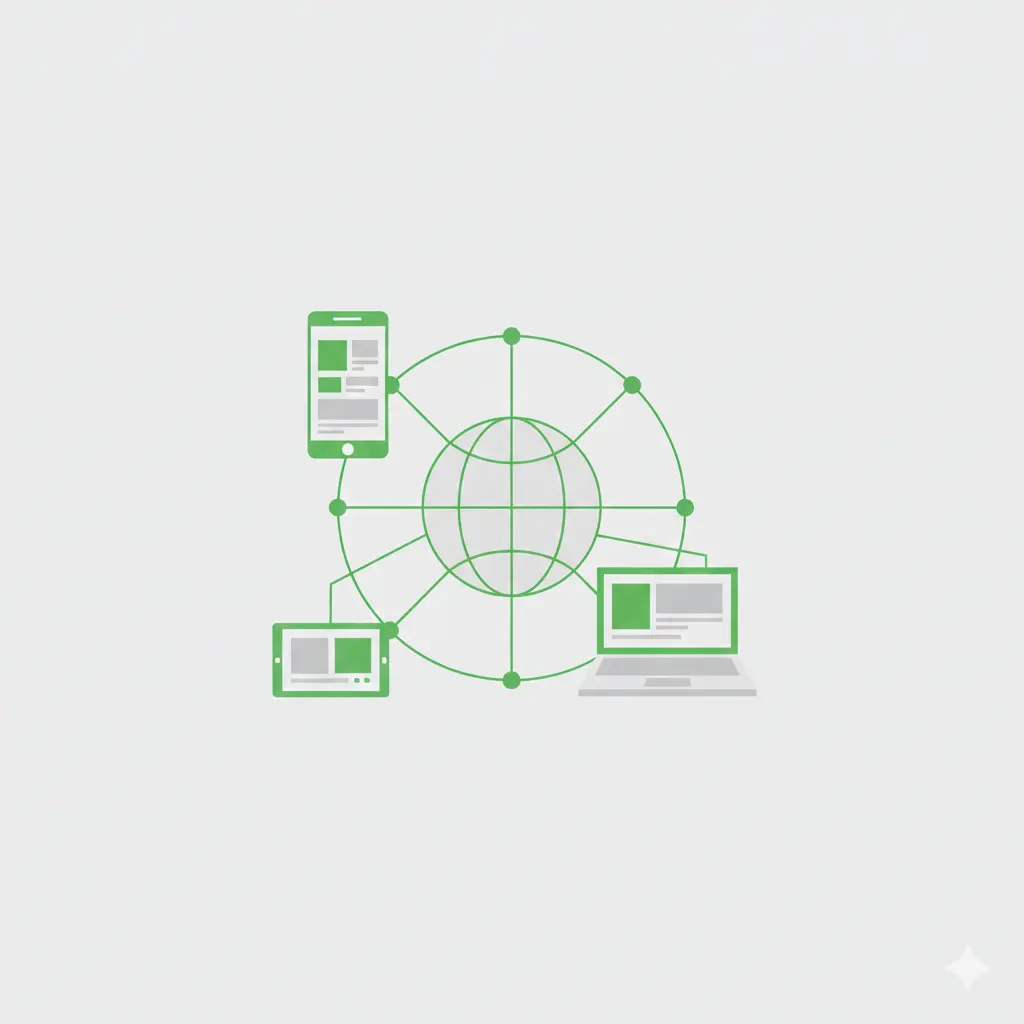
You run a business and you want to attract more customers from the internet. The first thing you have probably heard is "you need a website". The truth is that a website alone is not enough.
In this article you will learn what an online presence actually means, why most businesses get it wrong, and the concrete steps you can take starting today. With fresh 2026 data.
97% of consumers read online reviews for local businesses
And 76% of people who search for something nearby visit a business within a day (Google, 2016). If you are not visible online, customers go to the competition.
What is an online presence?
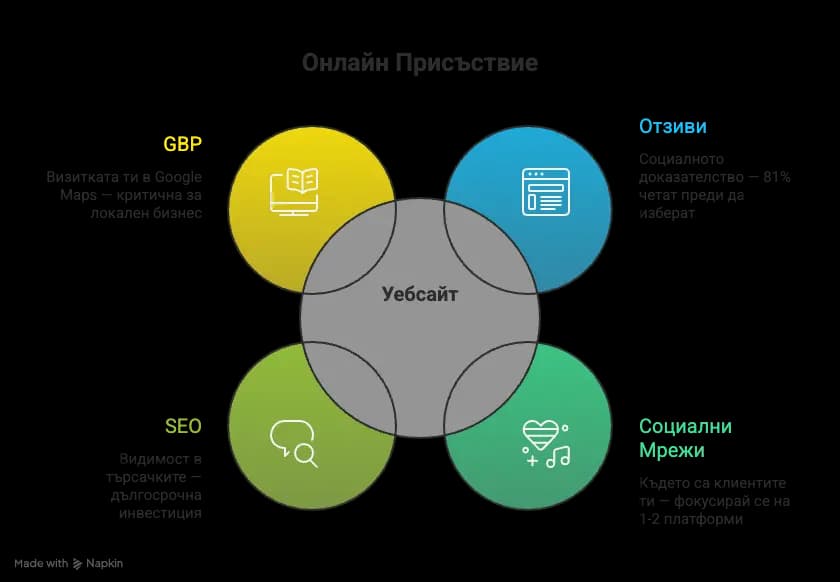
Your online presence is the sum of every place on the internet where your business can be found. It is not just a website - it is your full "digital footprint".
Imagine you open a physical shop downtown. You have a beautiful window, but no sign outside, you are not on Google Maps, and nobody knows you exist. That is what a website without an online presence looks like - pretty, but invisible.
Most online experiences start with a search engine. If you are not there when customers search, they go to the competition.
Key idea: Online presence is "where you are" on the internet. Digital marketing is "how you bring people there". You need both, working together.
Why online presence matters (2026 data)
Here is what the data says, and why a business with no online presence loses customers every day:
46%
of all Google searches have local intent
58%
of web traffic comes from mobile devices
Local search dominates. Nearly half of all Google searches come from people looking for something nearby - "restaurant near me", "accountant [city]", "dentist open now". If you are not visible in those searches, you are missing real customers.
Mobile users move fast. 88% of people who search for a local business on their phone visit a store within a week, and 76% within a day (Google, 2016).
Speed is critical. 53% of mobile visits are abandoned if a site takes more than 3 seconds to load (Google, 2016). On mobile, every second counts.
"In 2026, digital presence is no longer optional - it is a baseline requirement for survival and growth. Customers research, compare, and decide online before they ever contact a business."
- NASE (National Association for the Self-Employed)
The 5 elements of a strong online presence
Your online presence is not one thing - it is several connected pieces. Each one plays a role:
1. Website - your "digital office"
The website is the only place on the internet that you fully control. Social networks change their algorithms, directories have their own rules - but the site is yours. It is the base that every other channel points back to.
Around 83% of small businesses in the US already have a website (Clutch, 2025). The ones without lose credibility before the customer even gets in touch.Learn more about web development →
2. Google Business Profile - your card in Google Maps
For local businesses, GBP is often more important than the website itself in the short term. Businesses that show up in the local 3-pack get 126% more traffic than those that don't (SOCi).
And here is the best part - it is free. There is no excuse for not having an optimized profile.See our GBP guide →
3. Social networks - where your customers actually are
5.24 billion people use social networks (DataReportal, 2025). The average user spends about 2 hours 21 minutes a day on them. But you do not need to be everywhere - it is better to be active on 1-2 platforms than dead on 5.
For B2B, LinkedIn is the leading platform for lead generation. For B2C and local businesses, Facebook and Instagram.
4. Reviews - social proof
Google is the most-used review platform - 71% of consumers used it to evaluate local businesses in 2026 (BrightLocal). Reviews are some of the strongest social proof you have.
Good news: you do not need 5 stars. Purchase likelihood actually peaks between 4.0 and 4.7 stars (Spiegel Research Center, Northwestern). People trust realistic ratings more than perfect ones.
5. SEO - visibility in search engines
SEO (Search Engine Optimization) decides whether people find you when they search for what you sell. It is not magic - it is a mix of technical work, content, and trust signals.
For local SEO, the biggest factor is your Google Business Profile signals (around a third of local pack ranking), followed by on-page SEO, reviews, and links (Whitespark).Learn more about SEO services →
Google Business Profile - the biggest lever for local business
Google Business Profile (GBP) is a free tool that puts you in Google Maps and the local search results. For local businesses, it is probably the single most valuable piece of an online presence.
GBP signals are the biggest ranking factor for the Local Pack - roughly a third of the weight (Whitespark). Profiles with photos get 42% more direction requests and 35% more clicks (Google).
How to optimize GBP:
1. Fill in EVERY field. Exact business name (no extra keywords), full address, phone, hours including holidays, the right category, and a description up to 750 characters. Complete profiles rank better - 75% of top-ranked businesses have a filled-in description (Localo).
2. Pick the right category. Picking the wrong category is, according to local SEO experts, the single most damaging factor for local rankings. Google offers around 4,000 categories - find the most accurate one for your business.
3. Add quality photos. Logo, cover, exterior and interior shots, products, team. At least 10 photos, but more is better.
4. Ask for reviews actively. Ask every happy customer. Send them a direct link. And respond to every review, positive or negative.
5. Post regularly. GBP has a posts feature - share news, offers, events. Active profiles rank better.
Heads up: 16% of businesses get more than 100 calls a month from GBP alone (BrightLocal). If your profile is not optimized, those are customers you are losing.
5 mistakes to avoid
These are the mistakes I see all the time from businesses trying to build an online presence:
1. "Build it and forget it"
A lot of businesses pay for a website, launch it, and never touch it again. A site without maintenance loses positions in Google.Fix: Plan at least monthly updates - new photos, articles, fresh info.
2. Ignoring Google Business Profile
For local businesses, GBP often brings in more customers than the website itself. An empty profile means missed opportunities.Fix: 2 hours to fill it 100%, then 15 min a week for posts.
3. Trying to be everywhere
Facebook, Instagram, TikTok, LinkedIn, YouTube... A lot of businesses try to be everywhere and end up doing nothing well.Fix: Focus on the 1-2 platforms where your customers actually are.
4. Inconsistent info (NAP)
NAP = Name, Address, Phone. If the info is different on Google, Facebook, and your site, Google gets confused and ranks you lower.Fix: Identical info everywhere, including formatting.
5. Expecting instant SEO results
"Why am I not on page one after a week?" - the most common question. SEO takes time. If someone promises first place in a week, run.Fix: Plan for 3-6 months. For quick results, use Google Ads.
How much does building an online presence cost?
One of the most common questions. Here is a realistic breakdown for a small to mid-sized business:
| Item | DIY | Professional |
|---|---|---|
| Domain | ~15€/yr | ~15€/yr |
| Hosting | 30-75€/yr | Included |
| Website | 0€ (Wix/WordPress) | 750-2,500€+ |
| Google Business Profile | Free | 100-250€ optimization |
| Basic SEO | Free (your time) | 150-500€/month |
| TOTAL (first year) | ~50-100€ + a lot of time | 1,250-4,000€+ |
The DIY route works if you have the technical skill and 50-100+ hours of free time. You learn how it all works, but results come slower and mistakes get expensive.
The professional route saves time, delivers results faster, and avoids expensive mistakes. It does need an investment though.See a detailed website pricing breakdown →
Our take: If the budget is tight, start with Google Business Profile (free) and a simple website. As the business grows, invest in a professional site and SEO. The most important thing is to start - perfect is the enemy of done.
Online presence checklist
Use this checklist to gauge how ready your online presence is. Click each item to tick it off:
Checked: 0 of 10
Sources
- BrightLocal: Local Consumer Review Survey (2026) (accessed June 2026)
- BrightLocal: Google Business Profile Insights Study (accessed June 2026)
- Think with Google: Local Search to Store Visit (2016) (accessed June 2026)
- Statista: Share of Website Traffic from Mobile Devices (accessed June 2026)
- Clutch: State of Small Business Websites (2025) (accessed June 2026)
- DataReportal: Digital 2025 Global Overview (accessed June 2026)
- Whitespark: Local Search Ranking Factors (accessed June 2026)
- Localo: Analysis of 2 Million Google Business Profiles (accessed June 2026)
- Spiegel Research Center (Northwestern): How Online Reviews Influence Sales (accessed June 2026)
- NASE: Why Every Small Business Needs a Strong Online Presence in 2026 (accessed June 2026)
Frequently asked questions
Ready to build your online presence?
Get in touch for a free consultation. We will review your current online presence and suggest concrete steps to improve it.
Free consultation