


You have a website, but competitors always show up above you in Google? When someone searches "air conditioning [your city]" or "dentist downtown", they see your competitors, not you. The problem is usually in the meta data - the invisible code that tells Google what your page is about.
In this article you'll learn how to optimize your meta data for local SEO so you can outrank the competition in local searches.
46% of all Google searches have local intent
In this article:
What is local SEO?
Local SEO (Local Search Engine Optimization) is the process of optimizing your online presence to attract more customers from location-based searches. When someone searches "hairdresser near me" or "auto shop in [city]", Google shows local results - including the Google Maps ranking (Local Pack), which is the most visible part of those results.
According to BrightLocal, 80% of US consumers search for local businesses online at least once a week, and 32% do so daily. The trend is similar in most markets - people search "near me" instead of opening the yellow pages.
- 28% of nearby smartphone searches result in a purchase (Google, 2016)
- 76% of people who search nearby on a smartphone visit a business within a day (Google, 2016)
- 80% of consumers search for local businesses at least weekly (BrightLocal)
Sources: Think with Google, BrightLocal
Here's the opportunity: many local businesses still neglect the basics of local SEO - incomplete profiles, generic meta data, no location targeting. If you do it right, you gain a serious edge over them.
Which meta data matters for local SEO?
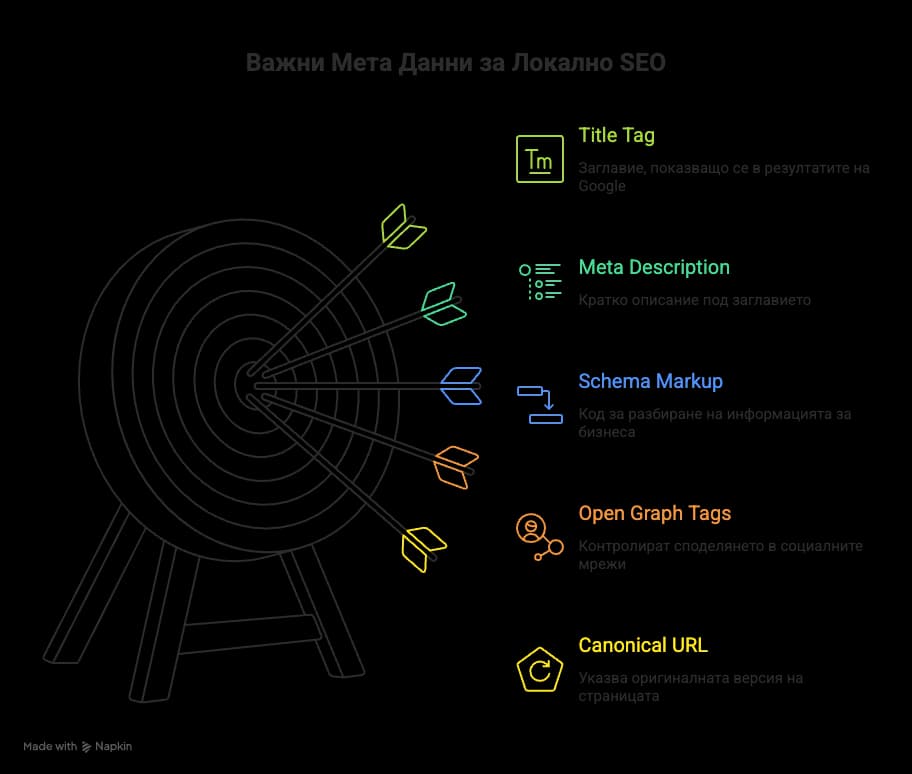
Meta data is information in the HTML code of your page that visitors don't see directly, but it's critical for search engines. Here are the ones that matter most for local SEO:
1. Title Tag (Page title): The title shown in Google search results. The most important meta element for SEO. For a local business it needs to include both the keyword AND the location.
2. Meta Description: The short description below the title in Google. It doesn't directly affect rankings, but it strongly influences CTR (how many people click through).
3. Schema Markup (Structured data): Special code that helps Google understand information about your business - address, phone, opening hours, reviews.
4. Open Graph Tags: Control how your link looks when it's shared on social media.
5. Canonical URL: Tells Google which is the "original" version of the page if you have similar content on several URLs.
Title Tag: How to optimize it for local SEO
The title tag is one of the most important on-page SEO factors, second only to content in practitioner surveys (Search Engine Journal). For a local business, the right title can be the difference between page one and page three in Google.
Optimal structure for a local title tag
// Formula:
[Keyword] + [City/Area] | [Brand]
// Examples:
Dentist Downtown Chicago | Dr. Smith
Air Conditioning Installation Austin | CoolHome
Hair Salon Brooklyn Heights | Beauty Studio
Rules for an optimal title tag
Length: 50-60 characters. According to Zyppy's study of 80,000+ titles, Google rewrites about 61% of all title tags - and titles that exceed the length limit get rewritten even more often. If your title is too long, Google will either truncate it or write its own.
Keyword - at the front. Google gives more weight to words near the start of the title. "Dentist Chicago" works better than "Dr. Smith - your dentist in Chicago".
City or area - non-negotiable. For local searches, including the location is critical. If you target a specific neighborhood, include it: "Brooklyn Heights" instead of just "Brooklyn".
Brand - at the end. If you have a recognizable brand, place it at the end after a separator (| or -).
CTR statistic
In one documented case, optimizing a title tag lifted organic clicks by 57%. It's one of the fastest SEO wins you can get.
Source: Hurrdat Marketing
Meta Description: How to win the click
Meta description doesn't influence ranking directly, but it has a massive impact on CTR (Click-Through Rate) - how many people click your result. Higher CTR = more visitors at the same ranking position.
According to a study by Ahrefs, Google rewrites meta descriptions about 63% of the time. But well-optimized descriptions that match the search intent are more often left alone.
Structure of an effective meta description for a local business
// Formula:
[Social proof] + [USP] + [Location] + [CTA]
// Example (155 characters):
Over 500 happy customers in your city. Professional AC installation with 2-yr warranty. Free site visit. Call now!
Elements of a winning meta description
Length: 150-160 characters. Longer descriptions get truncated. On mobile devices the visible portion is even shorter, so put the most important info at the start.
Social proof: Years of experience, number of clients, number of projects, rating. For example: "15+ years of experience", "500+ happy customers", "4.9/5 on Google".
USP (Unique Selling Proposition): What sets you apart from the competition? Free delivery, warranty, 24/7 service, best prices.
Location: Include the city or area you're targeting. It signals to the user that you're relevant to their search.
CTA (Call-to-Action): A clear next step: "Call now", "Get a free quote", "Book online".
| Element | Bad example | Good example |
|---|---|---|
| Title Tag | Welcome to our website | Air Conditioning [City] | CoolHome |
| Meta Description | We offer various services. | 15+ yrs experience in your city. AC installation with 2-yr warranty. Free site visit! |
LocalBusiness Schema: Structured data
Schema markup (structured data) is special code that helps Google understand information about your business better. According to Search Engine Journal, LocalBusiness schema increases your odds of showing up in rich results and the local pack.
Schema markup isn't a direct ranking factor, but it helps Google display your business with richer information in the results - opening hours, ratings, address right in the SERP.
What to include in LocalBusiness Schema
Required fields: Business name, address (street, city, postal code), geographic coordinates (latitude, longitude), opening hours.
Recommended fields: Phone, email, price range, rating (aggregateRating), logo, photos, business description.
// LocalBusiness Schema example (JSON-LD):
{
  "@context": "https://schema.org",
  "@type": "LocalBusiness",
  "name": "CoolHome AC",
  "image": "https://example.com/logo.webp",
  "address": {
    "@type": "PostalAddress",
    "streetAddress": "15 Main Street",
    "addressLocality": "Your City",
    "postalCode": "10001",
    "addressCountry": "US"
  },
  "geo": {
    "@type": "GeoCoordinates",
    "latitude": 43.4170,
    "longitude": 24.6067
  },
  "telephone": "+359879406809",
  "openingHoursSpecification": [{
    "@type": "OpeningHoursSpecification",
    "dayOfWeek": ["Monday", "Tuesday", "Wednesday", "Thursday", "Friday"],
    "opens": "09:00",
    "closes": "18:00"
  }],
  "priceRange": "$$",
  "aggregateRating": {
    "@type": "AggregateRating",
    "ratingValue": "4.9",
    "reviewCount": "127"
  }
}
How to add Schema Markup
WordPress: Use plugins like Rank Math, Yoast SEO, or Schema Pro. They generate schema automatically.
Next.js / Custom site: Add a JSON-LD script in the <head> section or in the body of the page. We do this automatically on every site we build.
Validation: Use the Schema.org Validator or Google Rich Results Test to verify that the schema is correct.
How to analyze the competition
Before you optimize your own meta data, take a look at what the competitors ranking above you are doing. Here's how:
1. Search like a customer: Open an incognito window and search for the keywords you want to rank for: "[service] [city]". Write down the first 5 results.
2. Analyze the title tags: Which keywords are they using? Do they include the city? How long are they? Is there something that makes them stand out?
3. Read the meta descriptions: What social proof are they using? What's their USP? Is there a call to action?
4. Check the schema markup: Use a Chrome extension like "Structured Data Testing Tool" to see what structured data they have in place.
5. Check Google Business Profile: How many reviews do they have? What's their rating? How often do they post? For a full guide to optimizing your profile, see how to rank in Google Maps.
"Your primary Google Business Profile category is the most important local ranking factor - so choosing the wrong one is one of the most damaging mistakes you can make."
Common mistakes in local SEO
Avoid these mistakes, which we see a lot at local businesses:
1. Duplicate meta data: The same title tag and description on every page. Every page needs unique meta data.
2. No location in the title tag: "Hair salon services" instead of "Hair salon downtown [city]". Without location, you're competing with the whole world.
3. Inconsistent NAP: Different names, addresses, or phone numbers on different platforms. Google loses trust if the information contradicts itself.
4. Ignoring mobile users: 57% of local searches happen on mobile devices. If your site doesn't work well on a phone, you're losing more than half of your potential customers.
5. The "set and forget" approach: SEO isn't a one-off task. Meta data needs to be monitored and optimized regularly based on how it performs in Google Search Console.
6. No reviews: According to Whitespark, Darren Shaw argues review recency belongs in his top 5 ranking factors for 2025. Fresh reviews = better rankings.
Local SEO meta data checklist
Use this checklist to make sure you haven't missed anything:
Conclusion
Local SEO is one of the most effective marketing strategies for small and mid-sized businesses. With properly optimized meta data, you can outrank competitors who have much bigger budgets.
Start with the title tag - include the keyword and the city. Write an attractive meta description with social proof and a call to action. Add LocalBusiness schema markup. And most importantly, stay consistent with your NAP information everywhere.
If you want to beat the competition in local results but don't have time for the technical details, we can help.
Sources
- BrightLocal: Local Consumer Review Survey (2026) (accessed June 2026)
- Think with Google: Local Search Conversion Statistics (2016) (accessed June 2026)
- Zyppy: Google Title Rewrite Study (accessed June 2026)
- Ahrefs: How Often Does Google Rewrite Meta Descriptions? (accessed June 2026)
- Search Engine Journal: Title Tags as a Ranking Factor (accessed June 2026)
- Whitespark: The Most Underrated Local Ranking Factor (2025) (accessed June 2026)
- Search Engine Journal: Schema for Local SEO Guide (accessed June 2026)