
Your best employee is on sick leave. A client calls with a specific question about your return policy for items over 100 EUR. The new colleague who picks up the phone has no idea. They check the shared Google Drive, scroll through WhatsApp messages, ask two other people - and fifteen minutes later, the client is still waiting. This scene plays out in companies every single day. A local AI knowledge base solves it: all your company information in one place, with an AI layer that gives instant answers based on your own documents.
Employees spend 20% of their workweek just searching for information
McKinsey estimated back in 2012 that employees spend about 20% of their workweek searching for information - and with today's volume of digital documents, the problem has only gotten worse. A knowledge management system can reduce this by up to 35% (McKinsey Global Institute).
What is a local AI knowledge base
Think about where your company knowledge actually lives right now. Part of it is in emails. Part is in a Google Drive folder that nobody remembers how to navigate. Part is in WhatsApp groups. And a significant chunk is simply in people's heads - which means when someone leaves or is unavailable, that knowledge disappears.
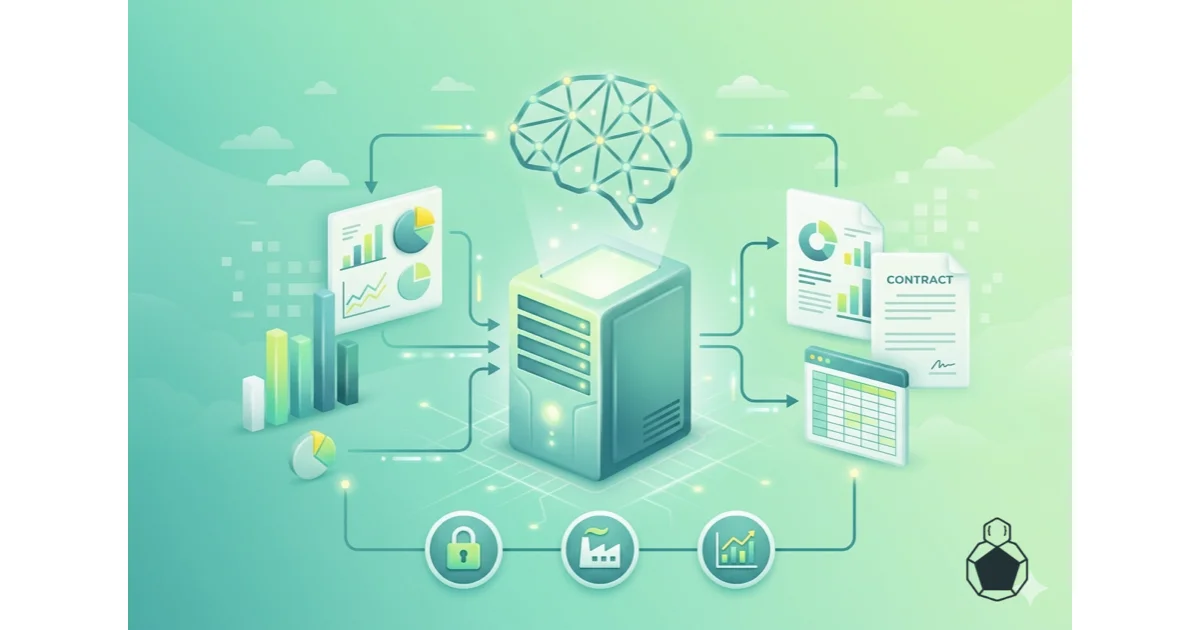
A local AI knowledge base is the solution: all company information - procedures, product specs, pricing rules, FAQ, internal policies - collected in one structured, searchable place, with an AI layer on top that understands natural language questions.
The word "local" is key. It means your data stays on YOUR servers or in your own cloud. Nothing is sent to external AI providers for training. Your confidential documents, client data, and pricing never leave your control.
Think of it this way: a local AI knowledge base is like a colleague who has read every document in your company and remembers everything perfectly. You ask a question in plain language, and they give you a precise answer with a reference to the source document.
Why "local" and not just ChatGPT
ChatGPT, Gemini, and Claude are fantastic tools for general questions. But they have two fundamental problems when it comes to company knowledge:
They don't know YOUR business
ChatGPT knows what return policies are in general. But it doesn't know YOUR specific return policy, YOUR product specs, or YOUR internal procedures. Every answer is generic.
Your data goes to US servers
When you paste client contracts, pricing, or internal memos into ChatGPT, that data is sent to OpenAI's servers. Under GDPR, this can be a compliance problem, especially with sensitive client data.
A local AI knowledge base solves both problems at once. It answers based on YOUR actual documents, and the data never leaves your infrastructure.
| ChatGPT / Gemini | Local AI knowledge base | |
|---|---|---|
| Knows your products | No | Yes |
| Knows your procedures | No | Yes |
| Data stays private | No - sent to US servers | Yes - your servers only |
| GDPR compliant | Problematic | Full compliance |
| Cites source documents | No | Yes - with page/section |
| General knowledge | Excellent | Limited to your docs |
The trend
By 2028, Gartner expects 33% of enterprise software to include agentic AI, up from less than 1% today. RAG-based knowledge systems are a key part of that trend. The EU AI Act, with main obligations for high-risk systems enforceable from August 2026, reinforces the importance of data sovereignty.
How it works (without the jargon)
You don't need to be technical to understand this. The whole system works in three simple steps:
Your team writes and organizes documents
Procedures, product specs, FAQ, pricing rules, internal policies - all in plain text files or a structured folder (like an Obsidian vault or a shared drive). These are normal documents that anyone can read and edit without AI. The key: organize them well, because the AI is only as good as the documents it reads.
AI indexes and "understands" the content
The system reads all your documents and creates a searchable index. In technical terms, this is called RAG (Retrieval-Augmented Generation). In simple terms: the AI remembers where every piece of information is, so when someone asks a question, it knows exactly which document and which paragraph to look at.
Anyone asks a question, gets an answer with source
A colleague types a question in normal language. The AI searches your documents, finds the relevant passages, and formulates a clear answer. Crucially, it shows where the answer came from - which document, which section - so you can verify it.
The human-readable layer is important. Your documents are still normal text files that anyone can open and edit. The AI layer is on top, not instead of. If you are already using structured notes (Markdown files, Notion, or similar), you are halfway there. And if you want the AI to also talk to your website visitors, it can be connected to an AI chatbot as the user-facing front-end.
Important: the AI does not invent information. It only works with what is in your documents. If a procedure is not documented, the AI will say it does not have that information. This is a feature, not a bug - it prevents hallucinated answers.
Which businesses benefit most
Not every business needs a knowledge base right now. But if any of these descriptions fit you, the value is immediate:
Service companies with procedures
Accounting firms, law offices, marketing agencies, consulting firms. You have dozens of internal procedures that staff need to follow precisely. A knowledge base lets anyone find the correct procedure in seconds instead of asking around.
E-commerce with big catalogs
Support agents need instant access to specs, compatibility info, and stock rules for products they cannot physically see. Instead of digging through spreadsheets or waiting for a colleague to answer, they ask the AI and get an answer with the source document attached. This alone can cut average response time in half.
Companies with employee turnover
The new hire asks questions and gets accurate answers from day one.
Multi-location businesses
When you have multiple offices, branches, or remote teams, information drifts. One location follows an old procedure, another follows the updated one. A single knowledge base keeps everyone on the same version, and you can see which documents were accessed most - giving you insight into what confuses people.
What it looks like in practice
"What's our return policy for items over 100 EUR?"
New employee gets the exact policy, with the source document and last update date, in under 5 seconds.
"Is product X compatible with product Y?"
Support agent gets a spec-based answer instantly, instead of calling the warehouse or searching through PDFs.
"What was our procedure for handling complaints about delayed shipments?"
Manager gets the full SOP with step-by-step instructions, without asking three different people.
If you run an online store and want to see how AI helps specifically with e-commerce, check out our article on AI for online stores.
A well-structured knowledge base also helps with customer acquisition. When your team can answer questions faster and more accurately, clients notice. If you are looking for more ways to grow, here is how to attract more customers online.
Your data stays yours
This is the part that most business owners underestimate until something goes wrong. When your team uses ChatGPT for work, every prompt they send goes to OpenAI's servers in the United States. Client contracts, pricing strategies, internal memos - all of it.
The GDPR reality
The EU AI Act, with main obligations for high-risk AI systems enforceable from August 2026, reinforces data sovereignty requirements. Combined with GDPR, this means businesses need to know exactly where their data goes when they use AI tools.
Source: EU AI Act Implementation Timeline, 2026
With a local AI knowledge base, the picture is completely different:
- No data leaves your infrastructure. Your documents stay on your server or in your cloud under your control. The AI processes queries locally.
- No training of external models. Nobody else's AI is learning from your confidential information. Your competitive advantages stay yours.
- Full audit trail. You know exactly what the system accessed, when, and who asked what. Important for compliance and internal governance.
For Bulgarian businesses, this is particularly relevant. Client data, contracts, pricing, employee information - all of this falls under GDPR protection. A local AI base is the only approach that keeps you fully compliant while still giving your team the power of AI. And once data sovereignty is in place, it opens the door to broader AI automation across the organization.
How much effort is maintenance
Let's be honest: the initial setup takes effort. Organizing scattered company knowledge into a structured format is the hardest part. But here is the thing - you need to do this anyway. Right now, that knowledge is chaotic and inaccessible. Organizing it has value even without the AI layer.
What the effort looks like
What about costs?
Costs vary significantly based on the size of your document base, the number of users, and how many integrations you need. A simple setup for a small team can start from a few hundred euro, while more complex setups with integrations cost more. The best approach is to discuss your specific situation.
If you want a specific estimate, reach out to us and we will evaluate what makes sense for your case.
Getting started
You don't need to document everything before you start. Begin with the knowledge that your team needs most often:
Once you have a structured knowledge base, the AI layer is the easier step. And if you want the knowledge to be accessible to customers too, an AI chatbot can serve as the front-end. The chatbot answers visitor questions based on your knowledge base, 24/7, without your team lifting a finger.
For broader AI automation of business processes - documents, emails, reports - a knowledge base is often the foundation on which everything else is built.
From our own experience
We use a structured knowledge base ourselves for our internal processes - from project documentation to maintenance procedures. The difference in how quickly a new team member gets up to speed is enormous. What used to take days of shadowing and asking around now takes a few hours of reading and asking the system.
Where to start if you want to explore this
Not sure if a knowledge base makes sense for your business? Let's talk. We will look at your current situation, the volume of documents you have, and whether the investment is worth it for your specific case. No obligation.
Frequently asked questions
Sources
All sources retrieved on 18 June 2026.
- McKinsey Global Institute, The social economy: Unlocking value and productivity through social technologies, 2012 - mckinsey.com
- Gartner, Top 10 Strategic Technology Trends for 2025: 33% of enterprise software will include agentic AI by 2028, up from less than 1% in 2024 - gartner.com
- EU AI Act, Implementation timeline - high-risk system obligations from August 2026 - artificialintelligenceact.eu
- European Commission, AI Act: Implementation and Application, 2025 - digital-strategy.ec.europa.eu