
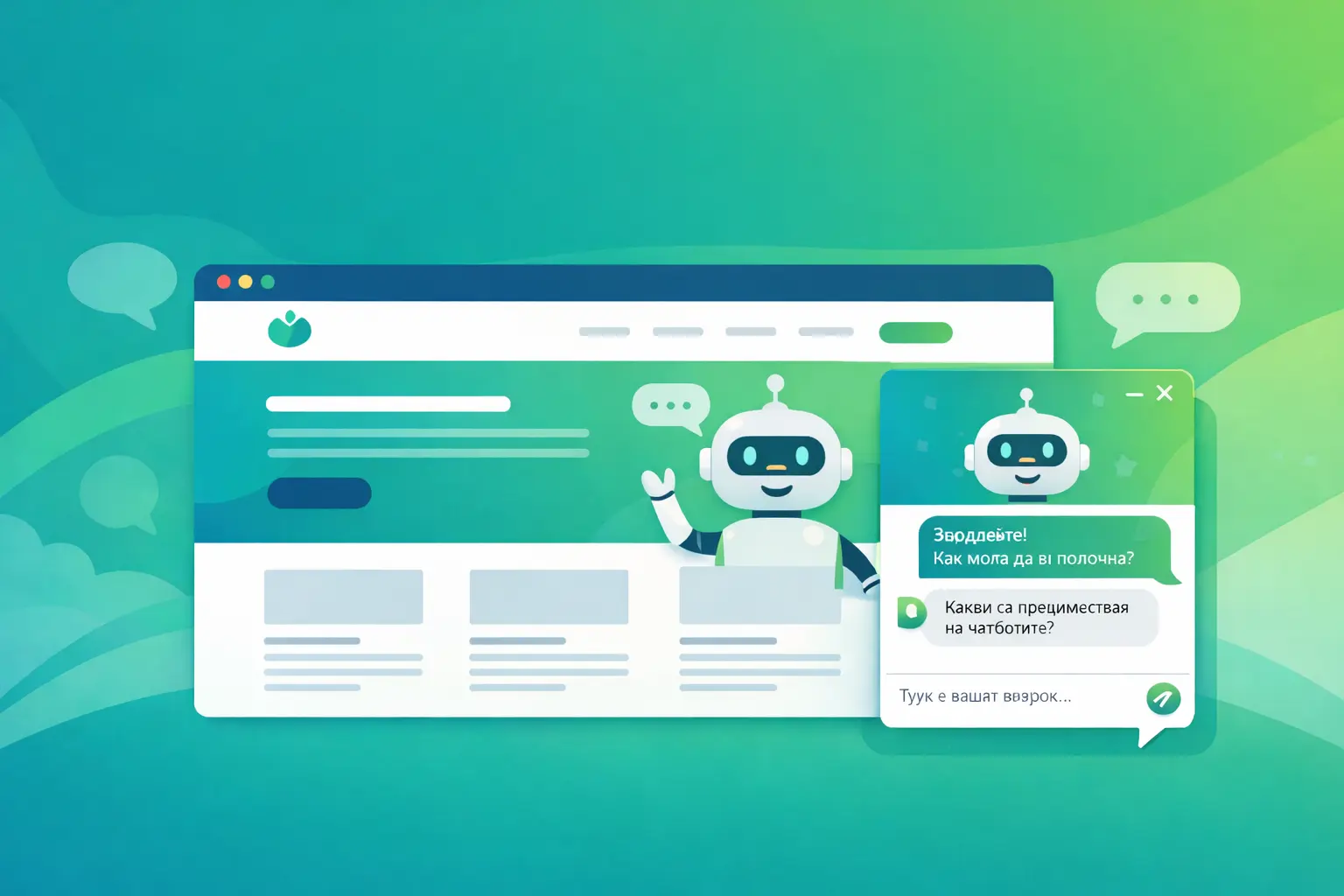
- An AI chatbot is software that uses artificial intelligence (NLP and machine learning) to hold natural conversations and answer customers without a human.
- Unlike scripted bots, it understands context and intent, learns over time, and works 24/7 in multiple languages.
- The business value is mainly cost savings: Gartner expects AI to resolve 80% of common service queries and cut operational costs by around 30% by 2029.
- Pricing in Bulgaria: basic from 500 €, professional from 1,000 €, enterprise from 2,600 € (plus monthly hosting and maintenance).
You've heard of chatbots. Maybe you've chatted with one on a website and wondered whether it was a person or a machine. In 2026, AI chatbots are no longer the future - they're the present, and they're changing the way businesses talk to their customers.
In this article you'll learn what an AI chatbot is, how it works, the different types of chatbots, and most importantly - how one can help your business serve customers 24/7.
By 2029, AI will autonomously resolve 80% of common customer service queries, cutting operational costs by around 30%
Source: Gartner (2025)
In this article:
What is an AI chatbot?
An AI chatbot (artificial intelligence chatbot) is a software program that uses machine learning and natural language processing (NLP) to simulate human conversation. It's a digital tool that can answer customer questions without human intervention.
Unlike ordinary chatbots that follow rigid scripts, an AI chatbot understands context, learns from conversations, and can answer questions it has never seen before. It analyzes not just the words, but the intent behind them.
According to Salesforce, 66% of customer service teams already use AI agents in 2026, nearly double the 39% from a year earlier. The conversational AI market, meanwhile, is projected to reach €40 billion by 2030 (Grand View Research).
How does an AI chatbot work?
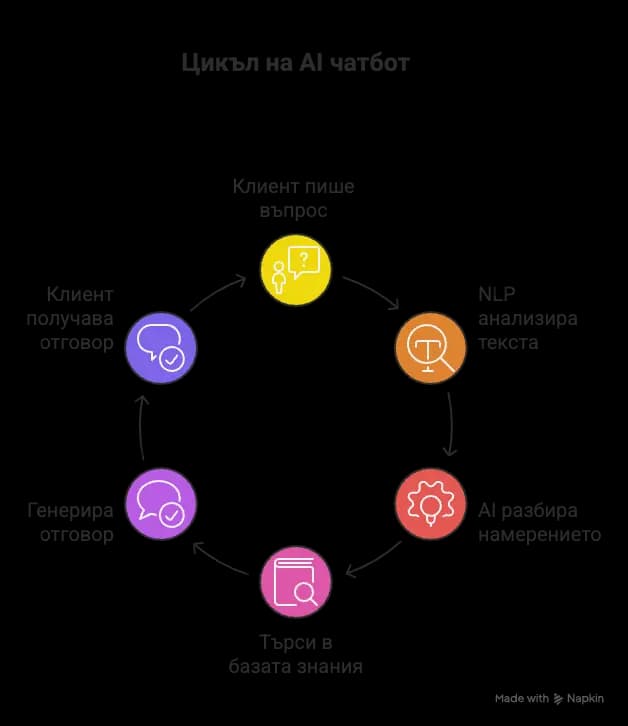
Modern AI chatbots use several key technologies that work together:
1. Natural language processing (NLP): When you type a question, the AI chatbot "understands" it - it analyzes the words, grammar, and intent behind the message. It doesn't look for an exact keyword match; it grasps the meaning. For example, "how much will shipping to Sofia cost" and "Sofia delivery price" are understood as the same question.
2. Machine learning: The AI chatbot has been trained on millions of example conversations. That lets it "understand" context and give relevant answers even to questions it sees for the first time. With every interaction, the chatbot gets better.
3. Knowledge base: The chatbot has access to information about your business - products, services, prices, FAQ, return policy. When you update your prices, you simply update the knowledge base and the chatbot immediately starts quoting the new prices.
4. Response generation: Once it understands the question, the AI chatbot generates a natural-sounding reply. According to Intercom, modern AI agents resolve a large share of conversations on their own. Its Fin agent averages 67% autonomous resolution, even on more complex queries.
How it works in practice:
Customer asks: "Hi, how much does delivery to Plovdiv cost and how long does it take?"
AI chatbot understands: Intent: delivery info | Location: Plovdiv | Questions: price + time
AI chatbot replies: "Hi! Delivery to Plovdiv is free for orders over 25 EUR. For smaller orders the fee is 3 EUR. Delivery time is 1-2 business days. Anything else I can help with?"
What are the types of chatbots?
Not all chatbots are equal. Understanding the differences will help you pick the right solution:
Rule-based chatbots
These run on predefined scripts and decision trees. The user picks from buttons and menus. They're the simplest and cheapest chatbots, but they're limited - they don't understand free text and can't answer questions outside the script.
AI chatbots (recommended)
These use artificial intelligence and NLP to understand context and intent. They can hold natural conversations and learn from every interaction. This is the sweet spot between price and capability - they understand free text, learn over time, and give personalized answers.
Virtual assistants
The most advanced AI systems - like ChatGPT, Claude, Siri, or Google Assistant. They can carry out complex tasks, integrate with multiple systems, and even work with voice. They're used for enterprise solutions, but they're pricier and harder to integrate.
| Feature | Regular chatbot | AI chatbot |
|---|---|---|
| Question understanding | Exact keywords only | Natural language and context |
| Learning | Doesn't learn | Improves over time |
| Typos | Doesn't understand | Understands despite mistakes |
| Personalization | Same for everyone | Adapts tone and style |
| Feel | Obviously a robot | Feels like talking to a person |
What are the benefits of an AI chatbot for business?
According to McKinsey, 88% of organizations now use AI in at least one business function, up from 78% a year earlier. Here's why:
24/7 availability: The AI chatbot works around the clock, including 11 PM on a Sunday or New Year's Day. It never calls in sick and doesn't take vacation. Customers get an answer instantly, no matter when they reach out.
Instant response: While a human handles one query at a time, an AI chatbot can handle many conversations in parallel and reply in seconds. According to SuperOffice, the average company takes over 12 hours to answer a support email, and 62% never reply at all. A chatbot answers instantly, around the clock.
Cost savings: An AI chatbot takes the repetitive questions off your team's plate - one piece of broader AI automation for business processes. According to Gartner, AI handling routine queries leads to about a 30% reduction in customer service operational costs.
More sales: The AI chatbot engages visitors and guides them toward a purchase, offering personalized recommendations and helping with the decision. According to Zendesk, 67% of consumers are now ready to let AI handle tasks like order tracking and product recommendations.
- ~30% lower operational costs by 2029 (Gartner)
- 67% of conversations resolved autonomously by Intercom's Fin agent
- 88% of organizations use AI in at least one business function (McKinsey, 2025)
- €75B in contact-center agent labor savings from conversational AI in 2026 (Gartner)
Sources: Gartner, Intercom, McKinsey, Gartner (contact centers)
Where are AI chatbots used?
AI chatbots are used in nearly every industry. Here are concrete examples:
From online stores cutting abandoned carts to bookings, B2B lead qualification, and customer support, the use cases keep growing. According to Zendesk, 67% of consumers already trust AI to handle tasks like order tracking and product recommendations.
Online stores (e-commerce): Answers questions about products, sizes, and availability. Helps with product selection ("Looking for a gift for a 30-year-old man"). Provides info on shipping, returns, and warranties. Recommends additional products (upsell and cross-sell). Result: fewer abandoned carts and more completed purchases.
Booking-based services: Schedules appointments automatically (hair salon, doctor, gym). Checks availability in real time and sends reminders. Syncs with Google Calendar. Result: fewer missed appointments and round-the-clock booking.
B2B companies: Qualifies leads with questions ("How many employees do you have?", "What's your budget?"). Routes to the right product or service. Gathers info before a sales call. Result: better-qualified leads reaching your sales team.
Customer support: Answers most routine questions without human intervention. Works 24/7, including holidays. Hands off complex cases to a person with the full history. Result: much shorter response times and lower support costs.
"By 2029, agentic AI will autonomously resolve 80% of common customer service issues without human intervention, leading to a 30% reduction in operational costs."
How much does an AI chatbot cost?
The price depends on the complexity of the solution. From our work building chatbots for Bulgarian businesses, here are realistic ranges for 2026:
Price ranges:
from 500 €
Basic AI chatbot
from 1,000 €
Professional
from 2,600 €
Enterprise
Basic AI chatbot: from 500 €
Includes: answers business questions, collects contacts, supports your main language, basic analytics. A good fit for small businesses that want to get started with AI automation.
Professional: from 1,000 € - recommended
Includes everything from basic, plus: CRM integration, appointment booking, product recommendations, detailed analytics. This is the best price-to-quality ratio for most businesses.
Enterprise: from 2,600 €
Includes everything from professional, plus: multiple integrations, custom AI training, multilingual support, priority maintenance. For companies with complex needs and high query volume.
Monthly costs: On top of the one-off price, there are monthly costs: hosting (15-50 €/mo), maintenance (25-100 €/mo), API costs (depend on volume). Ask about the total cost of ownership before committing.
Checklist: What to consider before you deploy
Answer these questions before picking an AI chatbot:
Conclusion
The takeaway is simple: in 2026 an AI chatbot is an accessible investment from 500 €, working 24/7, handling repetitive questions, and paying for itself within months. AI chatbots are no longer a luxury technology reserved for large corporations - they're an accessible tool that can transform how you serve customers and generate sales.
If you're losing customers outside business hours, if your team keeps answering the same questions, or you simply want to boost efficiency - an AI chatbot might be the solution you're looking for. The investment pays back in months, and the benefits keep paying off for years.
Sources
- McKinsey: The State of AI (accessed June 2026)
- Gartner: Agentic AI to resolve 80% of service issues by 2029 (accessed June 2026)
- Intercom: Fin AI agent resolution data (accessed June 2026)
- Zendesk: 2025 CX Trends Report (accessed June 2026)
- SuperOffice: Customer Service Benchmark Report (accessed June 2026)
- Gartner: Conversational AI to cut contact-center labor costs by €75bn in 2026 (accessed June 2026)
- Salesforce: State of Service (accessed June 2026)
- Grand View Research: Conversational AI Market 2030 (accessed June 2026)