

In short:
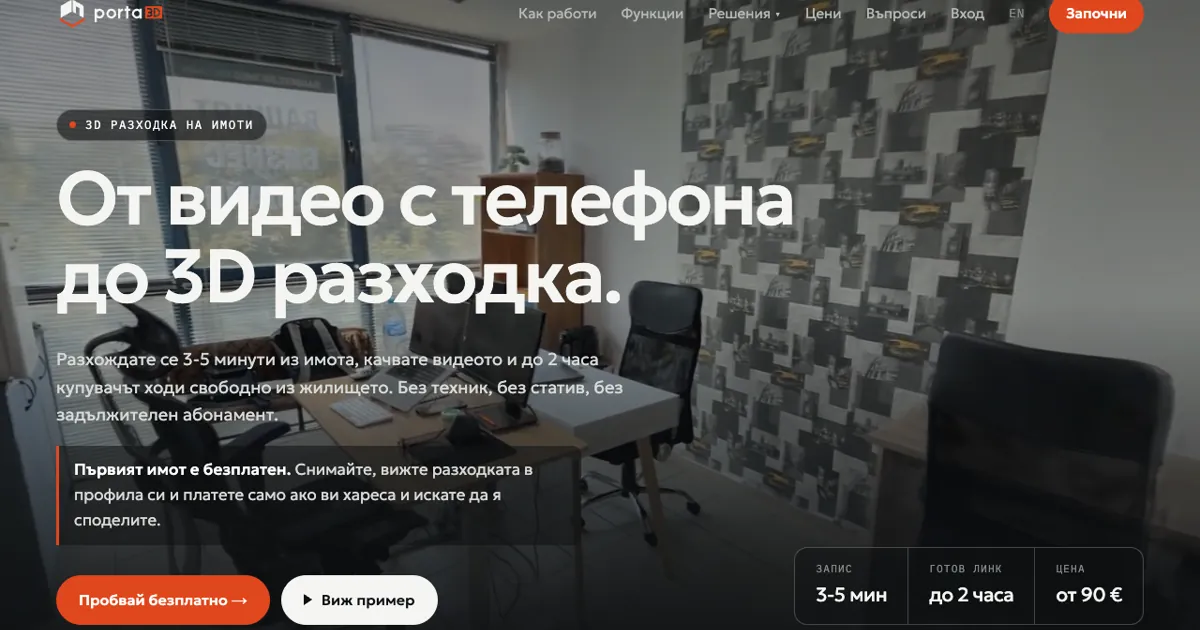
Porta 3D is our own product: the agent records a property with a phone for 3-5 minutes, and within 2 hours the buyer walks through it in 3D in the browser. It grew out of my years as a real estate agent and was built by Coding Turtles in September and October 2026. Below are the story, the decisions we made, and what we learned. The one thing I don't describe is exactly how the processing works.
Before I wrote my first line of code, I sold apartments. And the thing I cared about most was how a property looked online, because that decides whether anyone calls at all.
This article is the story of Porta 3D, a service for 3D property walkthroughs: where the idea came from, what turned out to be hard, what we decided along the way, and what any business that wants to build its own product can take from it.
In this article:
How it started: an agent with a gimbal
As an agent I always wanted to show every property in the best possible way. So I shot videos with a gimbal and took professional photos of the properties I was selling. It worked: good visuals bring more calls, and the calls come from people who already know what they're coming to see.
The problem I saw every day
But it took time that most agents simply don't have. Photos and video show the property the way the photographer chose. The buyer can't turn left, can't see how the bedroom connects to the corridor, and still has to come in person to understand the space. A big part of the viewings ended with “it's not what I imagined”.
Years later, as a developer, I came back to the same problem with new tools in hand.
Buyers are ready for virtual viewings
In a Rocket Mortgage survey of more than 800 home buyers, three out of five said they would be willing to buy a home after only a virtual tour, and prerecorded tours left them more satisfied than live video tours or panoramic photos.
The idea: the agent records it alone, with a phone
The idea was simple: any agent should be able to show a property, on their own and with nothing but a phone, the way I tried to show mine. Not as a set of photos, but as a space you can walk through.
Why not 360 photos
360 tours already exist, and they're useful. But the buyer jumps from point to point and loses the sense of distance and of how the rooms connect. I wanted continuous movement, like walking through the door yourself.
Why not a technician with a special camera
Platforms like Matterport give an excellent result, but they need either a special camera or a phone on a tripod, point by point, plus a subscription. For an ordinary one-bedroom flat that's a lot of work. The agent is at the property anyway, for the viewing or to take the photos. If the recording fits into those few minutes, it gets done. If it needs an hour and a tripod, it doesn't.
The hardest part: a good walkthrough from a phone
Making a 3D model from a video is something research labs have been doing for years. Making it look good from an ordinary phone, recorded by someone who isn't a specialist, in a small flat with white walls and a big window, is a different story. That's where most of the time went.
Our office as the test subject
We tested on our own office in Pleven: record, process, look, change one thing, record again. A lot of the ideas that sounded logical didn't work, and some small details turned out to matter far more than expected. The walkthrough of that same office is now the example on the Porta 3D home page.
What we learned about the recording
Some of it is public in the recording guide, because the agent needs to know it: use the ultra-wide 0.5x lens, walk slowly, turn the phone smoothly, switch off the TVs, and don't let doors move during the recording. A walkthrough is only as good as the video it starts from.
What I don't describe here
How exactly the video becomes a walkthrough stays inside the team. That's the result of the most tests and the part that makes the difference between “it works” and “it looks good”. Everything else, I'm happy to share.
Everything around the walkthrough
A good walkthrough is only half the product. The other half is everything an agent touches: how they sign up, upload, pay, and share. This is the part that's our everyday work at Coding Turtles.
Uploading gigabytes from a phone
One walkthrough video weighs from a few hundred megabytes to a few gigabytes. We made the upload go in parts, straight to cloud storage, so it survives a weak mobile connection and doesn't pass through our servers. The first real test was a 1.5 GB video uploaded from a phone.
Processing without anyone touching it
When a video arrives, the system checks it and starts the processing on cloud servers with graphics cards by itself. Those servers are paid only while they work, so an empty week costs nothing. When the walkthrough is ready, it goes online and the client gets an email. On October 8, 2026, that first 1.5 GB video went through the whole chain on its own in about 45 minutes.
A viewer that feels like a viewing
Around the walkthrough we built a strip with the rooms, a floor plan with “you are here”, and a joystick for walking on a phone. On a computer you move with the keyboard and the mouse. The buyer installs nothing; it opens in the browser from a link, an embed on the agency's site, or a QR code on the sign.
Payments, teams, and an admin panel
Payments go through Stripe Checkout, accounts and data through Supabase. Agencies invite their agents into a shared account, and in the admin panel we see every walkthrough, its status, and who it belongs to. These are the same building blocks we use for client projects with accounts and payments.
The full list of what we built, with screenshots, is in the Porta 3D case study.
Decisions we made, and why
Most of the important decisions weren't technical. They were about who does what, who pays when, and whom we sell to.
| Decision | Why |
|---|---|
| The agent records, not us | We don't send a technician. The agent is at the property anyway, and waiting for a visit is exactly what makes 3D tours expensive and slow. |
| The first property is free | You see the finished walkthrough in your account and pay only if you want to share it. Nobody has to believe us on our word. |
| Pay per property, subscription optional | One-bedroom €90, two-bedroom €110, VAT included. Agencies that record regularly agree on a subscription, but nobody is forced into one. |
| Redo or refund | If a walkthrough doesn't work out because of us, we redo it or give the money back. If the problem is in the recording, we say exactly what to record again. |
| English first | In Bulgaria few people search for virtual tours. The site is in English for Europe, and Bulgarian visitors land on the Bulgarian version automatically. |
The name took longer than expected
“Vizit” clashed with Visit Bulgaria. “Vlez” (Bulgarian for “come in”) didn't sound right. We settled on Porta, which works in many languages and doesn't box us into apartments only. But “porta” alone reads like a company that makes gates and doors, so the logo became “porta” with a “3D” tag, and the brand is Porta 3D.
What we learned
A few things that apply to any business that wants to build its own product, not only in real estate:
- Start from a problem you've lived. I didn't have to guess what agents need. That saved weeks of wrong turns.
- Test on the real thing early. Our office showed more in one afternoon than any theory.
- The product is the whole chain. A great result is worthless if uploading is painful or nobody knows when it's ready.
- Be honest about the limits. The walkthrough shows the property truthfully, but it's not for measuring. We say that on the site, and it builds more trust than any promise.
- Let people try before they pay. A free first property removes the biggest question: “will it work for me?”
Frequently asked questions
Sources
The takeaway
Porta 3D came from a problem I lived as an agent and was built with what we do every day as an agency. The hardest part wasn't the website but the result, and the most important decisions were about people, not code. If you want to see what came out of it, open Porta 3D and walk through our office.
Have an idea for your own product? Get in touch or see our software development service.