
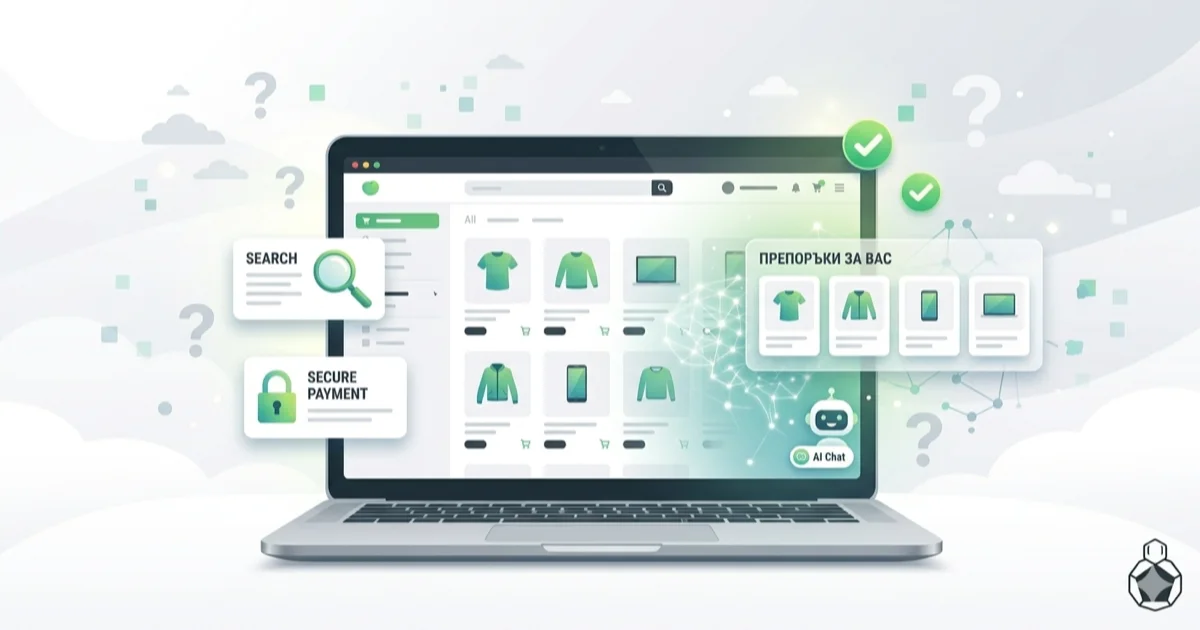
AI in ecommerce sounds like something only Amazon can afford. It is not. A Bulgarian store with 200 products can use AI today to recommend the right product to the right customer, answer questions at 3 AM without hiring night staff, and write unique descriptions for hundreds of items in hours instead of weeks. What actually works, what it costs, and where to start.
AI personalization drives 10-15% revenue lift for ecommerce
McKinsey found that personalization most often drives a 10-15% revenue lift, with company-specific gains spanning 5-25% depending on the sector and execution. 71% of consumers expect personalized interactions and 76% get frustrated when they do not get them.
What AI for an online store actually means
Forget the sci-fi version. AI for a store with 200 to 2,000 products is not a robot that runs your business. It is a set of tools that do specific jobs faster and better than a human can at scale: analyzing what each customer likes, answering the same 20 questions for the 500th time, or writing descriptions for 800 products without going insane.
77% of e-commerce professionals already use AI daily in 2025, up from 69% in 2024 (Shopify, 2026). The tools are ready. The question is not whether to use AI, but which part of your store benefits most.
These are the four areas where AI gives the biggest return for a typical Bulgarian store. Each one is practical, tested and available today - not a startup pitch. If you are still building your store, see our guide on e-commerce store development.
Personalized product recommendations
"Customers who bought X also bought Y" - you have seen it on every big store. The difference is that now a small store can have it too. AI tracks what each visitor browses, clicks and buys, then suggests products that match their taste. It is not guessing. It is pattern recognition across thousands of interactions.
On the product page
Show "similar products" or "goes well with" based on what other buyers combined. Increases average order value.
In the cart
Suggest add-ons before checkout. A phone case buyer sees a screen protector. A paint buyer sees brushes.
In emails
Personalized product picks in follow-up emails based on browsing history, not random promotions.
On the homepage
Returning visitors see products tailored to their interests, not the same generic banner every time.
What to expect
McKinsey reports 10-15% revenue lift from personalization for ecommerce. Salesforce data shows 39% of consumers - and over half of Gen Z - already use AI for product discovery (Salesforce, 2025). The lift comes from showing each visitor products they actually want, not a random list.
AI chatbot for customer service
"Is this in stock?", "When will my order arrive?", "Can I return this?". The same questions, over and over. An AI chatbot answers them instantly, 24 hours a day, 7 days a week, without hiring anyone. And it does not just repeat canned answers - modern AI chatbots understand context and give useful, specific replies based on your product data and policies.
Sources: Tidio, Intercom, IBM, 2026.
| Tool | AI capability | Price | Best for |
|---|---|---|---|
| Tidio Lyro | Up to 67% auto-resolved | Free plan available | Small stores, WooCommerce |
| Intercom Fin | 50%+ tickets resolved | €1 per resolution | Growing stores, SaaS |
| Custom chatbot | Tailored to your data | From 1,000 EUR | Specific needs, full control |
For a deeper look at how AI chatbots work and what they can do, see our guide on what is an AI chatbot. If you want a chatbot built for your store, we cover that in our AI chatbot service.
Automated product descriptions
This is the biggest pain point for stores with 500 or more products. Writing unique, SEO-friendly descriptions one by one takes forever. 15 minutes per product means over 125 hours for 500 items. AI cuts that to seconds per product - you feed it the specs, features and a few examples of your tone, and it generates a draft.
AI saves 75-88% of writing time. Source: Shopify AI Statistics, 2026.
- Unique descriptions. No more copy-pasted supplier text that Google ignores. Each product gets its own description, which helps SEO.
- Consistent tone. Train the AI with a few examples and every description sounds like your brand, not a random generator.
- Multi-language ready. For stores selling to multiple countries, AI generates descriptions in Bulgarian, English and other languages from the same source data.
AI generates drafts, not final copy. Always have a person review for accuracy, brand voice and factual claims - especially for technical products, supplements or anything with legal implications.
Abandoned cart recovery with AI
The average cart abandonment rate is 70.19% (Baymard Institute, 2025). That means about 7 out of 10 people who add a product to the cart leave without buying. The old approach is a generic "You forgot something" email. AI makes this smarter.
Sources: Baymard Institute, Dynamic Yield, 2025.
AI goes beyond a basic email reminder in several ways:
- Smart timing. AI learns when each customer is most likely to open an email and sends the reminder at that time, not a fixed 1-hour-later rule for everyone.
- Personalized content. The email shows the exact products left in the cart plus AI-picked recommendations based on browsing history.
- Smart exit-intent popups. AI detects when a visitor is about to leave and shows a targeted offer - a small discount, free shipping, or a related product - instead of a generic popup.
- Multi-channel sequences. Not just email. AI triggers follow-ups through SMS, push notifications or even a chatbot message based on what the customer is most likely to respond to.
Cart recovery is one of the fastest ways to see ROI from AI. Baymard Institute estimates that €240 billion in the US and EU alone is recoverable through better checkout design (Baymard, 2025). For more on turning visitors into buyers, see our guide on what conversion is.
For the payment step itself, see our guide on payments in an online store. If delivery is part of the friction, we also cover Econt, Speedy and BoxNow integration.
Dynamic pricing and inventory management
This is not about raising prices on desperate customers. It is about making smarter pricing and stock decisions based on data instead of gut feeling.
- Competitor price monitoring. AI scans competitor prices daily and flags products where you are significantly above or below the market. You decide what to do - it just gives you the data.
- Smart discounting. Instead of blanket 20% sales, AI identifies which products need a discount to move and which sell fine at full price. Protect your margins where you can.
- Demand forecasting. AI predicts which products will be in demand next month based on seasonal patterns, trends and historical data. Order stock before it runs out, not after.
- Overstock alerts. Get notified when a product is sitting too long. AI can suggest a targeted discount or a bundle to move it before it becomes dead stock.
For a small store, start simple: a spreadsheet with competitor prices updated weekly, plus a basic reorder alert when stock drops below a threshold. AI tools for this range from free Google Alerts to dedicated platforms like Prisync or Competera.
How much does AI for an online store cost?
It depends on what you need and how custom you go. This is a rough breakdown:
| Level | What you get | Cost range |
|---|---|---|
| Free / cheap | Tidio free tier, basic recommendation widgets, ChatGPT for descriptions | 0-50 EUR/month |
| Mid-range | Custom chatbot, personalization engine, AI-assisted descriptions | 1 000-3 000 EUR |
| Enterprise | Full AI stack: recommendations, chatbot, dynamic pricing, analytics | 5 000+ EUR |
The median payback on AI tooling investments is now 4.2 months, down from 7.8 months in 2024 (Shopify, 2026). That is fast enough for most stores to see a return within the same quarter.
ROI example
A store doing 50,000 EUR per month in revenue implements AI recommendations for a 10% lift. That is 5,000 EUR extra per month. Even a 2,000 EUR implementation cost pays for itself in two weeks. The math works at much smaller scales too - a 10% lift on 5,000 EUR monthly revenue is still 500 EUR extra.
Where to start
Do not try to implement everything at once. Start with the tool that gives you the fastest return with the least effort. This is a practical order:
AI chatbot (week 1)
Quick win. Set up Tidio or similar in a day. It starts answering questions immediately, even on the free plan. You see results the same week.
Product recommendations (month 1)
Add a "similar products" and "also bought" section to product pages and cart. Most platforms have ready plugins. Expect 5-15% lift in average order value.
Product descriptions (month 2)
Batch-generate descriptions for your catalog. Start with the top 100 products, review the quality, then scale.
Abandoned cart recovery (month 2-3)
Set up AI-powered email sequences. Connect them to your recommendation engine for personalized content.
If you want help implementing any of these, that is what we do in our AI automation service. We build custom AI solutions for online stores - chatbots, recommendation engines and automated content - tailored to your products and customers.
Common mistakes to avoid
AI is powerful, but it is easy to waste money if you approach it wrong. These are the mistakes we see most often:
- Trying to automate everything at once. Pick one area, prove it works, then expand. Trying to launch a chatbot, recommendation engine and AI descriptions in the same week leads to half-finished projects and frustration.
- Publishing AI content without review. AI-generated descriptions and chatbot answers need human review. One wrong product spec or a hallucinated feature can cost you a return, a bad review, or worse.
- Ignoring your data. AI is only as good as the data you feed it. If your product catalog has missing specs, wrong categories or no images, fix that first. Garbage in, garbage out.
- Expecting magic without effort. AI is a tool, not a magic wand. You still need to set it up right, review its output and adjust. The stores that win with AI are the ones that treat it as a team member that needs management, not a switch you flip.
From our practice
In our experience, the most common first step for our clients is an AI chatbot - results show within the first week. For one of the stores we worked with, the chatbot handled over 40% of customer questions without human intervention.
Frequently asked questions
Sources
All sources retrieved on 18 June 2026.
- McKinsey, The future of personalization and how to get ready for it - mckinsey.com
- Baymard Institute, Cart Abandonment Rate Statistics, 2025 - baymard.com
- Shopify, AI Statistics: Key Trends and Data for 2026 - shopify.com
- Salesforce, Connected Shopper Report, 2025 - salesforce.com
- Tidio, Customer Service Chatbot, 2026 - tidio.com
- Intercom, Fin AI Agent - intercom.com
- IBM, Chatbots can reduce customer service costs by up to 30% - ibm.com
- Dynamic Yield, Cart Abandonment by Device, 2025 - dynamicyield.com